Camping is better when you’re not babysitting batteries. A portable power station gives you an easy way to keep your gear running for a weekend outdoors, whether you’re keeping it simple or bringing a few extra comforts. The right one just makes the whole trip smoother.
But “best” means something different for everyone. It really comes down to the kind of trips you take and what you want to run while you’re out there. Capacity, output power, charging speed, ports, and solar can all matter, just not in the same way for every camper. So in this blog post, we’ll break down what matters most for camping and off-grid weekends, so you can choose the right one without overthinking it.

What Is a Portable Power Station
Before we get into features and how to choose the best one, it helps to get clear on what a portable power station actually is. A portable power station is a large rechargeable battery you bring with you to keep gear powered while you’re camping. Most models include a built-in inverter for AC outlets, plus USB ports and a 12V outlet, so you can plug in the same kinds of things you’d normally plug into a wall outlet, just with a limited amount of stored energy. The number of AC outlets matters because it affects how many things you can plug in at once, and the inverter’s wattage determines what it can actually run.
You charge it before the trip, and depending on the model, you can recharge it along the way too, like from a wall outlet, your vehicle’s 12V plug, or portable solar panels. Then at camp you use it for things like phones, lights, camera batteries, laptops, a small fan, or even an electric cooler or fridge, depending on the size and power requirements.
It’s not unlimited power, and it’s not meant to run everything nonstop. Think of it as a clean, quiet way to keep things charged at camp, with sufficient power.
Why Many Campers Prefer This Over a Gas Generator
It’s clean, quiet, and simple. Unlike traditional noisy generators, portable power stations provide a peaceful environment at your campsite, making them ideal for outdoor gatherings and off-grid adventures.
Instead of dealing with fuel and engine noise, you get a setup that you can use right next to your tent, RV, truck, or picnic table without the usual downsides.
Here’s what people like most about power stations at camp:
- No fumes or exhaust. You’re not running an engine at your campsite, so there’s nothing to vent and no gas smell hanging around.
- Much quieter. You can charge gear, run lights, or keep a cooler going without the constant generator noise, offering a quiet alternative to noisy generators.
- No fuel to store or spill. You don’t have to bring gas along, worry about leaks, or refill anything during the trip.
- Easier to use. Plug in your gear and go. There’s no pull start, warm-up time, or ongoing maintenance.
- More campground-friendly. Many campgrounds restrict generator hours, and even when they don’t, a power station is usually the more considerate option.
- Reliable power in emergencies. Portable power stations can provide emergency power during outages or urgent situations, making them a dependable backup for unexpected needs.
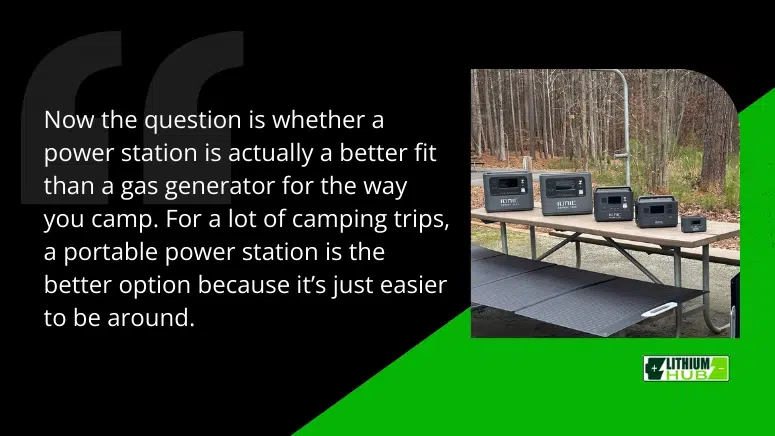
The main tradeoff is runtime. A portable power station has a set amount of stored energy unless you recharge it, while a gas generator can keep going as long as you’ve got fuel.
But that’s where solar comes into play! If your station supports portable solar panels, you can recharge during the day and stretch your power much longer on multi-day trips, making it perfect for off-grid power and extended stays without grid access.
What Size Portable Power Station Do You Need for Camping
Once you know you’re leaning toward a power station, the next step is sizing it. The right size mostly comes down to battery capacity, which is measured in watt-hours (Wh). Think of Wh like your fuel tank. The bigger the number, the longer you can run your gear between charges. Battery size directly impacts how much power you have available and how long you can run your devices, as well as the overall portability and weight of the unit. Just keep in mind that real-world usable power is usually a bit less than the label because of inverter losses and battery protection, so the usable AC power you get is often less than the stated capacity.
Understanding how much power you need is crucial for choosing the right battery size. Consider the total watt-hours your devices require to ensure your portable power station for camping can meet your needs.
Here’s a quick example to make that real. If something averages around 50W and you run it for 10 hours, that’s roughly 500Wh for the day. In the real world, you’ll usually get a bit less than the printed capacity once you factor in conversion losses, so it’s smart to leave some breathing room.
If you want a general starting point by camping style, these ranges are a solid place to begin:
- Estimate the hours per day you’ll use it
- Multiply watts times hours to get watt-hours per day
- Add a buffer so you’re not cutting it close, especially if you’ll use AC outlets
- Minimalist camping: About 200 to 500Wh for charging phones, running a few small lights, and keeping basic personal gear topped off.
- Weekend car camping: About 500 to 1,000Wh if you want more capacity for devices, lighting, and a few comfort items without worrying about running low.
- Base camp, overlanding, or longer trips: About 1,000Wh and up when you want longer runtimes, more flexibility, or you plan to run higher draw gear and don’t want to cut it close. Larger capacity models are especially useful for longer trips when you’re powering things like a small fridge, a CPAP, Starlink, or charging camera gear and multiple devices each day.
One more thing that can make a big difference is solar input. If you’re out for more than a night or two, recharging from a portable solar panel can help you stretch your power without constantly watching your battery percentage. Did you enjoy this post? You’ll probably like this one too: Generator Alternatives: Better Ways to Power Your Home, RV, or Campsite.

Best Power Stations Features That Actually Matter at Camp
After you’ve got a rough capacity range in mind, the details start to matter. This is where a power station can feel simple and convenient, or a little annoying.
Here are the features that actually make a difference at camp:
- Battery capacity (Wh): This is your “fuel tank”, so to speak. More Wh usually means more runtime, but it also means more size, weight, and cost.
- Battery type: Different chemistries can affect longevity and long-term performance, especially if you plan to use the station often.
- Inverter: This is what lets the station power AC outlets. It affects what you can run and whether certain devices start up smoothly. For those running sensitive electronics, look for UPS functionality with fast switching times (<10ms) to protect and power devices like computers or medical equipment during power outages.
- Ports: You’ll want the mix you actually use, like AC outlets, USB A, USB C, and 12V, so you’re not relying on adapters. For best results, seek units with multiple AC outlets, USB-A with Quick Charge, and USB-C PD (Power Delivery) for charging devices.
- Built-in light: A built-in light is a convenient feature for nighttime or low-light use, making it easier to operate the station in the dark.
- Fast charging: Fast charging capability reduces downtime by allowing the power station to recharge quickly via AC wall outlets, solar panels, or specialized chargers.
- Display and controls: A clear readout for remaining battery, plus power coming in and going out, makes it much easier to manage your usage.
If you focus on these basics first, comparing brands gets a lot simpler. You’ll know what matters for your trips, what you can ignore, and which features are actually worth paying for.
Ports & Outputs: What a Setup For Camping Gear Actually Uses
Capacity and wattage matter, but the ports are what you’ll notice every day at camp. If the outlet mix doesn’t fit your gear, or charging is slow where it counts, even a great-looking station can be frustrating.
Most campers end up using a small handful of ports over and over:
- 120V AC outlets: Useful for laptops, chargers, coffee makers, and anything that only plugs into a wall-style outlet. Having more than one is nice, so you are not constantly swapping plugs.
- 12V car-style outlet: Great for 12V gear like portable fridges and air pumps, and it can be more efficient than running everything through AC.
- USB-A ports: Still common for phones, headlamps, lanterns, and older charging cables.
- USB-C Power Delivery: This is the big one for modern gear like laptops, drones, and newer camera batteries.
USB-C is worth a closer look. Some stations have a USB-C port, but it’s low wattage, which is fine for phones and small devices. If you want to charge a laptop or other high-draw gear, make sure it supports USB-C Power Delivery at a higher watt rating. Otherwise, it’ll charge slowly, or it may not charge at all.
For most camping setups, it really comes down to having the right mix of ports for the gear you actually bring. Make sure you’ve got enough AC outlets for anything that needs a wall-style plug, plus a good spread of USB ports for phones and smaller devices. And if you want to charge a laptop or other high-draw gear, look for USB-C Power Delivery with a watt rating that can actually support it. If you plan to run a 12V fridge or other 12V gear, a 12V output is worth having too.
One last thing to check is whether the station limits power by port groups. Some models look great on the label, but certain ports can’t all run at full power at the same time. A quick skim of the specs usually clears that up.
Charging Options & Speed: AC, Car, and Solar
How you recharge matters just as much as how you use it, especially if you camp often or you’re out for more than a night or two.
The main ways to recharge a power station are:
- AC wall charging: Usually, the fastest and easiest way to charge at home before you leave. Some stations support fast AC charging and can recharge in a few hours, but it depends on the station’s capacity and the charger it comes with.
- Car charging: Useful while driving, but it’s usually a lot slower than wall charging.
- Solar charging: The best option for extending trips when you are staying off-grid. Optional solar panels can recharge portable power stations during the day, allowing you to use power at night without depleting the battery, and can help extend runtime for multi-day camping.
Charging speed isn’t just a nice extra. It matters when you’re packing last-minute, turning around between trips, or trying to keep the station topped off during a longer stay. And if you’re planning to use solar, don’t stop at “solar compatible.” Check the maximum solar input the station supports. That number tells you whether solar will actually recharge the battery or mostly just slow the drain.
Backup Power Smart Features & Ease of Use at Camp
Specs matter, but so does the day-to-day experience. A station can have great numbers and still feel frustrating if it’s hard to read, hard to control, or unclear about what’s happening.
Here are a few usability features that are actually worth paying attention to:
- A clear screen and simple controls so you can see battery percentage, watts going out, and watts coming in at a glance.
- Bluetooth and a user-friendly app: It seems optional until you use it. Quick access to charge and stats is one of those features you end up really appreciating.
- Clean port layout and labeling: Easier to find the right port fast, especially when you’re charging multiple things.
- Portability and comfort: Weight and shape matter more than people expect, so make sure it’s practical to lift, carry, and pack.
None of these changes raw performance, but they do change how smooth the weekend feels. If you’re choosing between two stations that are close in capacity and output, ease of use is often what makes one feel better than the other.
Battery Chemistry & Long-Term Durability
Battery chemistry sounds like a minor spec, but it has a big impact on how long your power station stays strong over time. Most models use either lithium-ion (usually NMC or NCA) or LiFePO4 (lithium iron phosphate). Both can work well at camp, but if you want the more durable, long-term option, LiFePO4 usually wins.
LiFePO4 is the better pick for most campers because it’s built for repeat use. It typically delivers a much longer cycle life, meaning it can handle a lot more charging and discharging before you notice a real drop in capacity. It’s also known for being more thermally stable, which is a nice benefit when you’re using and charging a battery system in warm weather, inside a vehicle, or in direct sun.
Lithium ion (NMC or NCA) is still common, mainly because it can pack a lot of energy into a smaller, lighter unit. If weight and portability are your top priority, that can be a plus. But in general, these packs tend to have a shorter cycle life than LiFePO4, so they can show wear sooner if you use them often.
If you’re comparing two stations that look similar, don’t rely on chemistry alone. Check the cycle rating and the warranty. Those two details usually tell you quickly whether a station is built for frequent weekends or more occasional trips.
Solar Recharging: Why It’s a Game Changer for Off-Grid Weekends

This matters most on multi-day trips, base camp style weekends, and any setup where you’re running steady loads like an electric cooler, Starlink, or charging multiple devices daily. Even if solar doesn’t fully recharge your station every day, it can take a lot of pressure off your battery so you’re not cutting it close by the second night.
A few practical tips help you avoid disappointment:
- Check the station’s maximum solar input. This tells you how much solar power it can actually accept. A bigger panel won’t help if the station can’t take in that much power.
- Plan for real-world conditions. Shade, clouds, season, and sun angle all reduce output. You’ll rarely get the full advertised panel rating all day.
- If you want solar to do more than “help a little,” prioritize higher solar input and faster charging. That’s what turns solar from a nice add-on into something you actually feel on the trip.
If you camp off-grid often, solar support is one of the best ways to get more usable time without buying an oversized station just in case.
Brand, Warranty & Support: The Stuff That Matters After Specs
Once you’ve nailed down capacity and features, this is what separates a good pick from a frustrating one. Two stations can look similar on paper but feel very different to own depending on warranty and support.
Here are the details worth checking before you buy:
- Warranty length and what it actually covers. You’re looking for clear terms and an easy process, not just a big number.
- Brand reputation for support. If something goes wrong, you’ll want responsive customer service and straightforward troubleshooting.
- Return policy. Especially if you’re buying online, a good return window takes a lot of risk out of the decision.
- Safety testing and certifications. A reputable brand should have clear documentation on testing and compliance.
If you’re deciding between two models, this is often the tiebreaker. Specs tell you what it can do. Warranty and support tell you what happens if it doesn’t do it the way you expected.
Conclusion: Pick the Station That Matches Your Camping Style
The best portable power station isn’t one specific model. It’s the one that fits how you actually camp. If you keep things simple, you’ll usually be happier with something smaller that’s easy to carry and quick to charge. If you bring more comfort gear, camp longer, or want more flexibility, you’ll want more capacity, faster charging, and a port mix that matches what you bring.
When you’re comparing options, keep it practical. Choose a capacity that fits your typical camping style, make sure the output can handle the gear you’ll run, and look for charging options that fit your routine. Then pay attention to the ownership stuff that matters after the purchase, like brand reputation, warranty terms, and support. If you get those pieces right, you’ll likely end up with a setup that feels easy and reliable instead of something you’re constantly managing.
Why Ionic Portable Power Stations Are Worth a Look
Once you’ve narrowed down the basics, it comes down to choosing a station from a brand you can actually count on. Ionic has built a strong reputation in the lithium space, and our portable power stations use LiFePO4 batteries for long cycle life and reliable performance on camping and off-grid weekends.
In real-world terms, we focus on the stuff that matters at camp. That includes practical port options for modern gear, clear displays that are easy to read, and solar charging support so you can stretch longer weekends without feeling boxed in by the battery you started with. Our stations also include Bluetooth with a user-friendly app, which makes it easy to check your charge level and basic stats without walking over to the unit every time.
And because brand reputation matters, we back our products with warranty coverage and customer support you can actually reach if you ever need help choosing the right model or troubleshooting an issue.
If you’re ready to narrow it down, start with your camping style and your typical gear, then compare Ionic models by capacity, output, and charging options. You’ll end up with a setup that feels simple to use and easy to rely on. Check out our lineup here.