When you’re shopping for a replacement battery for your car, truck, boat, RV, or other setup, you’ll probably notice labels like Group 24, Group 27, or Group 31. At first, it just looks like a random number, but it’s one of the first things to check if you want to avoid buying the wrong battery.
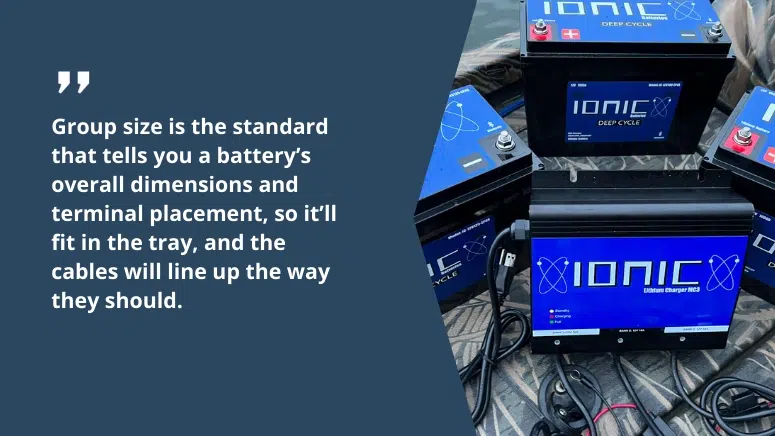
That’s why it’s one of the first things to check. With a lot of modern vehicles, where space is tighter, and there’s more electronics pulling power, fit isn’t a minor detail. If the battery is even slightly off, you can end up with one that won’t sit right, won’t clamp down securely, or has terminals that don’t match your cable reach.
In this post, we’ll break down what battery group size actually means, why it matters when you’re choosing a replacement, and how it affects the batteries you can use. We’ll also touch on battery chemistry so you can pick an option that not only fits, but also performs the way you need it to.
What Is Battery Group Size?
In simple terms, group size is a sizing system that maintains consistency across manufacturers. Whether it’s a Group 24, 27, or 31, those labels point to the exact shape and layout a vehicle is built to hold, so you’re not guessing on fit from brand to brand.
While group size mainly refers to physical fit, it’s often linked to performance in a practical way. A larger case can allow for higher CCA and reserve capacity, but the actual ratings still depend on the specific battery you choose. Either way, group size keeps the fit and terminal layout consistent so your electrical system can work the way it’s designed to, across a wide range of cars, trucks, and marine applications.
Common Battery Group Sizes and Where They’re Used
Now that you’ve seen what battery group size means, it helps to look at some of the most common sizes and the kinds of vehicles or setups they usually go in. That way, you can get a feel for where your own vehicle might land.
- Group 24 / 24F (cars/trucks + some marine/RV): A widely used size across a lot of sedans, SUVs, and practical daily drivers. 24F is a common terminal layout variation.
- Group 25 (cars): A common fit for many sedans and a range of imported vehicles. It’s a solid, widely used group size when the tray and terminals match.
- Group 35 (cars/crossovers): Very popular in compact and midsize vehicles and many crossovers.
- Group 48 (H6) (cars/SUVs): Extremely common in newer vehicles with higher electrical demand (more electronics).
- Group 94R (H7) (many European vehicles + some SUVs): A common European-style size that supports strong starting power and reserve capacity. (94R indicates a specific terminal layout.)
- Group 65 (full-size trucks/SUVs): A go-to size for many full-size trucks and larger SUVs, especially when you need strong cranking power.
- Group 27 (boats/RVs — especially house batteries): One of the most common sizes for marine and RV “house” use, where runtime matters.
- Group 31 (boats/RVs + heavy-duty): A very common pick for marine/RV systems and other high-demand setups when you want more reserve capacity and longer runtimes.
These aren’t the only BCI group sizes out there, but they cover most everyday cars, work trucks, and common recreational setups. Once you know which group size your vehicle uses, you can focus on choosing the right battery technology, whether that’s a standard lead acid option or a longer-lasting lithium upgrade in the same size. Learn more about What Does Reserve Capacity (RC) Mean on a Battery? (Simple Explanation) here.
Why Group Size Matters for Your Vehicle
Your vehicle’s battery group size doesn’t just affect physical fit. It can also influence performance. Let’s talk about those things.
Cold Cranking Amps (CCA): Larger batteries often come with higher CCA ratings, which means more starting power in cold conditions. If your group size is too small, the battery may struggle to turn over the engine, especially in winter.
Reserve Capacity (RC): A bigger group size can also mean more stored energy. RC measures how long the battery can power your vehicle’s electrical systems if the alternator stops working. If your vehicle has more electronics or you run extra accessories, you’ll usually benefit from a higher RC value.
Amp Hours (Ah): You may also see amp hours listed on some batteries, especially deep-cycle models. It’s a simple way to describe capacity, meaning how much energy the battery can supply over time
Fit still matters just as much as power. A battery that’s too small or the wrong shape might not secure properly in the tray, which can lead to vibration damage or loose connections. Terminal placement is also tied to group size, so mismatched terminals can make installation difficult or even unsafe.
For example, Group 31 batteries offer both a large case size and strong performance. Their higher CCA and RC ratings make them a solid pick for heavy-duty trucks, buses, RVs, and marine applications where reliability and endurance are critical.
Choosing the right group size ensures your battery not only fits, but it also delivers the starting power, reserve energy, and durability your vehicle depends on.
How To Determine the Right Battery Group Size for Your Vehicle
Choosing the right battery starts with matching the correct group size. That number tells you the case dimensions and terminal layout your vehicle is designed for, so the battery fits and the cables reach without any drama.
The easiest ways to find it are:
- Check your owner’s manual.
- Look at the label on your old battery for a BCI group number.
- Use a fitment guide on a trusted battery site by entering your year, make, model, and engine. This can also help if your current battery uses a different labeling system, like DIN or EN sizing, and you need the BCI group size equivalent.
Once you know the group size your vehicle calls for, you can:
- Make sure the battery will sit securely in the tray and reach the hold-down.
- Confirm the terminals line up with your cables.
- Compare performance ratings like CCA and reserve capacity within that same group size.
- Decide which chemistry you want in that size, such as flooded lead acid, AGM (absorbent glass mat), or a LiFePO4 lithium battery.
Sticking with the recommended group size keeps the fit simple. From there, you still want to choose the right battery type and ratings for how you use your setup.
Comparing Battery Types by Group Size (Lead Acid, AGM, and Lithium)
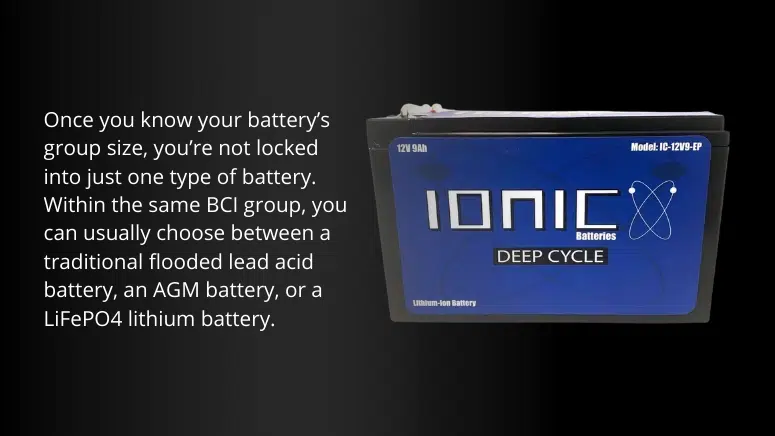
Once you know your battery’s group size, you’re not locked into just one type of battery. Within the same BCI group (for example, Group 25 or Group 31), you can usually choose between a traditional flooded lead acid battery, an AGM battery, or a LiFePO4 lithium battery that’s built to replace them.
One quick note, though. Group size tells you the fit, not the job. Some batteries in the same group size are built mainly for starting, others are built for deep cycle use, and some are marketed as dual-purpose. So you’ll want to compare apples to apples based on how you actually use the battery.
Here’s how they stack up within the same group size.
Flooded Lead Acid (Standard)
This is the basic, budget-friendly option. In some applications, an enhanced flooded battery is used as a step up from a standard flooded design. Flooded lead-acid batteries work well for many daily drivers and plenty of common marine and RV setups, but they:
- Have higher internal resistance
- Charge more slowly
- Need occasional maintenance (like checking fluid levels, in many cases)
- Don’t handle deep discharges or extreme heat as well as newer designs
AGM (Absorbed Glass Mat)
AGM batteries are a step up while keeping the same group size and general fitment:
- Lower internal resistance: They deliver power more efficiently and support higher loads.
- Faster charging: They typically recharge more quickly than standard flooded batteries.
- More stable voltage: They tend to hold voltage better under load, which helps vehicles with sensitive electronics.
- Sealed design: They’re spill-resistant and, in normal use, designed to be leak-proof, and they don’t require topping off water.
Because of this, AGM batteries are a strong choice for high-demand setups and harsh or hot environments, even though they usually cost about 40 to 100 percent more than comparable flooded lead acid batteries in the same group size. Depending on the model, you may also get special features like built-in handles or a charge status indicator.
That said, AGM is still a lead-acid battery, so you’re still dealing with more weight and a shorter overall lifespan compared to a LiFePO4 lithium upgrade in the same group size.
LiFePO4 Lithium Batteries
LiFePO4 lithium batteries can be a big upgrade in the same group size, but it’s important to match the battery to the use. Some LiFePO4 lithium batteries are built as LiFePO4 lithium starting batteries, and others are built for deep cycle applications, so don’t assume any lithium battery is automatically a direct replacement for what you have.
Compared to flooded and AGM batteries in the same group size, LiFePO4 lithium batteries typically offer:
- Much longer lifespan: Far more charge cycles, so you replace them less often
- Lighter weight: Often around half the weight of a similar lead-acid battery, which can help with efficiency and handling
- Very stable voltage: They hold a higher, more consistent voltage as they discharge, which supports modern electronics
- Fast charging and high efficiency: They charge faster and lose less power during charging and discharging.
- Maintenance-free, sealed design: No watering, no acid spills, and fewer corrosion issues around the terminals
The trade-off is price. LiFePO4 lithium batteries cost more up front than both flooded and AGM options. But if you choose the right LiFePO4 lithium starting batteries for vehicles, or the right deep cycle model for accessory loads, a LiFePO4 lithium battery in the correct group size can be the most cost-effective choice over the life of the battery.
Putting It All Together: Choosing the Best Battery for Your Vehicle
At this point, you know what group size means, where common sizes are used, and how flooded, AGM, and LiFePO4 lithium batteries compare. The last step is putting it all together for your own setup.
A simple way to decide is:
- Confirm your group size. Use your owner’s manual, your current battery label, or an online fit guide to lock in the correct BCI group.
- Match the power to your setup. Look at CCA and reserve capacity needs for your engine, climate, and accessories. Heavier electrical loads and colder weather call for stronger ratings within that same group size.
- Choose the chemistry that fits your priorities:
- Flooded lead acid if you want the lowest initial cost and have fairly basic needs.
- AGM if you want better performance and less maintenance in the same size.
- LiFePO4 lithium starting batteries if you care most about long life, stable power, and low weight.
If you’re running a truck, RV, marine system, or diesel equipment that uses a Group 31 battery, this is where our Group 31 lithium starter battery stands out. It keeps the Group 31 size your system is built for, while giving you stronger starting performance, much less weight, and a longer service life than a typical lead acid or AGM Group 31.
By starting with the right group size and then choosing the chemistry that fits how you actually use your equipment, you end up with a battery that fits right, starts reliably, and keeps your electrical system happy for years.
Why Choose an Ionic Lithium Starter Battery
At this point, you’ve got the basics down. You know your group size, you’ve seen where the common sizes show up, and you know the difference between flooded, AGM, and lithium. So when it’s time to replace a battery, you’re really deciding what you want to put back into that same group size.
Here’s what sets an Ionic lithium battery apart:
- Longer life: They’re designed to last several times longer than a typical lead acid or AGM battery in the same group size, which means fewer replacements and better value over time.
- More usable power: You get strong, steady power for longer, especially when you’re running lights, electronics, and accessories.
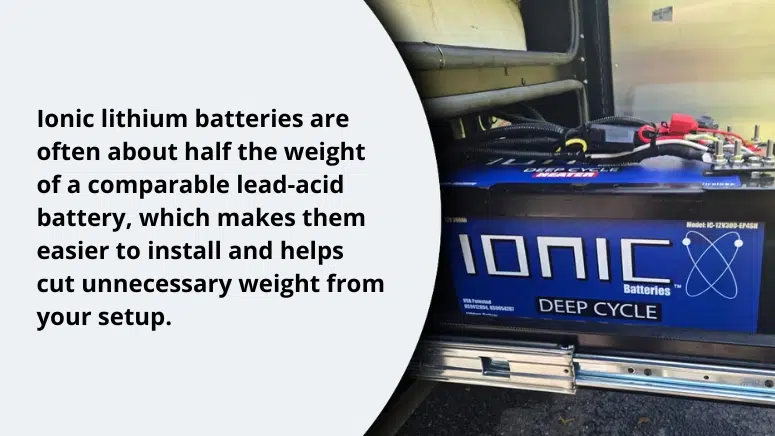
- Lower weight: Ionic lithium batteries are often about half the weight of a comparable lead-acid battery, which makes them easier to install and helps cut unnecessary weight from your setup.
- Built-in protection: Every Ionic lithium battery includes a battery management system that helps guard against overcharging, over-discharging, and other mishaps.
- Low maintenance: There’s no watering, no acid to spill, and far less corrosion at the terminals.
- Bluetooth monitoring: Instead of relying on a dash light or a guess, you can see your battery status right on your phone or smart device.
- Emergency start feature on starter batteries: Ionic lithium starter batteries include an emergency start feature that reserves power for when you need it and can be activated from the app or the button on the battery.
From there, you’re really just matching it to how you use it. Starting an engine? Go with an Ionic lithium starter battery built for cranking power. Running lights, electronics, or other loads for hours? That’s where an Ionic deep-cycle battery makes more sense. Ready to replace yours? Find the right Ionic battery for your group size today!