Nothing throws off an RV trip faster than pulling in, going to turn something on, and realizing the battery still isn’t charging. Maybe you’re plugged into shore power and expected the converter to do its job. Maybe you’ve been towing all day and figured the rig would’ve topped the battery off. Or maybe your solar setup looks normal, but the battery voltage keeps dropping anyway.
No AC power reaching the converter, a battery disconnect switch left off, a tripped breaker, a blown fuse, corroded or loose connections, or a battery that’s simply worn out. The key is checking the basics first, then narrowing it down from there, so you don’t spend money on parts you didn’t actually need.
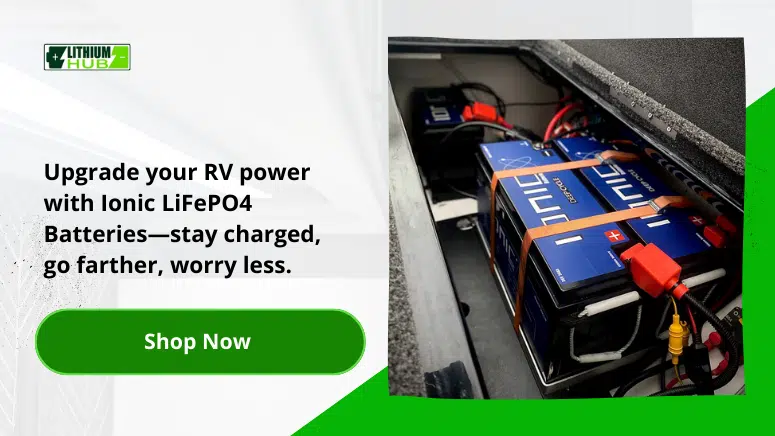
In this guide, we’ll walk through a simple, step-by-step troubleshooting process to help you find the real issue and get charging back on track. We’ll also include a quick note on lithium upgrades like Ionic LiFePO4 batteries, since features like faster charging, longer life than lead acid, and built-in Bluetooth monitoring can make it easier to keep tabs on your power system over time.
Common Signs Your RV Battery Is Not Charging Correctly
If you catch them early, you can save your trip and avoid running a battery down so far that it never fully comes back.
The Most Common Signs
- Dim or flickering lights: usually low battery voltage, or power getting choked by a loose or corroded connection
- Water pump sounds weak or pulses: pumps are quick to show low voltage, especially when the battery is dropping
- Fridge panel glitches or shows errors: even on propane, the control board still needs steady 12V power
- Fans running slower than normal: an easy one to miss at first, but a classic sign your 12V power is sagging
- You go to bed with power, then wake up with a low battery: the battery may not be charging properly, may not be holding a charge, or something is draining it
- Slides or jacks moving slowly: high draw loads make battery problems obvious fast, so slow movement is a big clue
Quick Voltage Checks That Actually Help
A quick voltage reading can tell you a lot, especially if you’re trying to figure out whether the battery is simply low or if it’s not charging the way it should. Here are some numbers to look for.
For lead acid batteries (flooded or AGM), check voltage after the battery has been resting for a bit (not actively charging, and not running heavy loads):
- Fully charged (resting): about 12.6 to 12.8V
- Around 50 percent (resting): about 12.2 to 12.3V
- Very low: below about 11.6V
For LiFePO4 (lithium), voltage stays steadier for most of the battery’s capacity, so use these numbers as quick benchmarks:
- Normal resting range: roughly 13.2 to 13.4V for much of its usable capacity
- Actively charging: often 13.8 to 14.6V (depends on your charger and battery)
- Very low: around 12.0V or lower usually means the battery is close to empty, or the BMS may have shut it down for protection
Side note: One nice thing about Ionic LiFePO4 batteries is that Bluetooth monitoring takes the guesswork out of it. Instead of relying on voltage alone, you can open the app and see your state of charge percentage, voltage, and whether the battery is charging or discharging in real time, and a lot more, which makes troubleshooting a lot faster.
Understanding How Your RV Battery Is Supposed to Charge
Before you chase down a charging issue, it helps to know how your RV is supposed to charge the batteries in the first place. Most rigs can charge in more than one way, and each path has its own weak spots. Once you understand which system is doing the charging in your setup, it gets a lot easier to figure out where things went sideways.
House Batteries vs. Starting Battery
Most battery not charging problems involve the house battery bank, not the battery that starts the engine. Here’s more on that:
- House batteries (coach batteries) power your 12V system, like lights, water pump, fans, and the control boards for appliances
- The starting battery (also called the engine or chassis battery in motorhomes) is mainly for starting the engine and is usually separated from house loads
If your lights, pump, and RV controls are acting up, you’re almost always dealing with the house side
How Towable RVs Charge
Towables usually charge the house battery in two main situations: while driving and while plugged in.
- While driving, the tow vehicle’s alternator can send charging power through the 7-pin connector to the trailer battery using a dedicated charge line
- While plugged into shore power, the RV’s converter turns 120V AC into 12V DC to run 12V loads and recharge the battery
- Some setups include a battery solenoid that only connects the charging circuit when the ignition is on, so the trailer battery can’t drain the tow vehicle when parked
How Motorhomes Charge
Motorhomes typically have more going on, but the basics are similar.
- While driving, the engine alternator charges the house batteries through a solenoid, isolator, or battery combiner
- On shore power or generator, a converter charger (or inverter charger) handles battery charging just like a towable RV
- Many motorhomes also run big 12V loads, like slides, leveling systems, and hydraulic jacks, off the house batteries, which can make charging issues show up faster
Did you enjoy this post? You’ll probably like this one too: Motorhome House Batteries 101: What RV Owners Should Know
Other Charging Sources You Might Have
Depending on the rig, you may also have one or more add-ons feeding the battery.
- Solar panels charge through a controller, usually MPPT or PWM
- DC to DC chargers can provide more consistent alternator charging, and they’re often used with lithium upgrades
- The more charging sources you have, the more helpful it is to troubleshoot one system at a time, so you don’t mix signals
Now that you know how RV battery charging is supposed to work, the next step is figuring out where the breakdown is. If you’re plugged into shore power, the usual culprits are the converter, a tripped breaker, a blown fuse, or a battery disconnect switch. If the issue shows up while towing or running solar, you’re looking at a different set of failure points. Next, we’ll walk through each scenario so you can narrow it down fast.
RV Battery Not Charging While Plugged Into Shore Power
This is one of the most common complaints: you’re plugged into a 30A or 50A pedestal, but the battery still goes dead. In most cases, the issue is somewhere in the charging path between the pedestal and the battery.
Shore power feeds your RV breaker panel, which powers the converter or charger. The converter then sends DC power to your house batteries so they recharge while you’re plugged in. If any link in that chain breaks, the RV can still feel powered, while the battery never actually charges.
Here’s the simplest way to work through it:
- Confirm the pedestal works: plug in a small appliance or use a plug-in tester
- Check the pedestal breaker: they trip a lot
- Inspect your shore cord and adapters: look for heat damage, loose blades, or burn marks
- Check your surge protector or EMS: it may show an error if incoming power is bad
- Check your RV breaker panel: look for a tripped breaker or GFCI feeding the converter
- Check your battery disconnect switch: if it’s set to Store or Off, the RV may run some 12V loads while plugged in, but the battery won’t receive a charge
- Check battery connections: corrosion, loose terminals, or a loose ground can block charging
- Look for a fuse or breaker in the charge line: many RVs have an inline fuse or resettable breaker between the converter and battery
If all of that checks out, do this quick converter test:
- Check battery voltage unplugged
- Plug into shore power and wait a few minutes
- Check again
If the voltage doesn’t rise, charging is not happening, or the battery still isn’t connected to the converter due to a fuse, breaker, switch, or wiring issue.
Battery Chemistry Matters Here, Too
Not every converter or charger is set up for every battery type. If your charging profile doesn’t match your battery chemistry, it can look like the battery isn’t charging even when the equipment is working. This comes up a lot with lithium upgrades, so it’s always worth confirming your converter is lithium compatible and set to the right profile.
If you’ve switched to LiFePO4, make sure your converter is lithium compatible and set up for the right charging profile. A mismatched converter is a common reason lithium batteries seem like they’re not charging well on shore power.
RV Battery Not Charging While Driving or Towing
It’s easy to assume that a few hours on the road will recharge your trailer battery. Sometimes it helps, but this charging path is usually slow, and it’s also one of the easiest ones to lose without realizing it. So you arrive at camp thinking you’ve been charging the whole drive, but the battery is still low.
First, make sure you’re actually on a setup that can charge while towing. A 7-pin connector is typically required. A 4-pin flat connector only runs trailer lights, so you shouldn’t expect any battery charging from that.

A Quick Test That Tells You a Lot
Grab a basic multimeter and do a simple before-and-after check:
- Check trailer battery voltage with the tow vehicle off
- Plug in the 7-pin connector
- Start the tow vehicle
- Check the voltage again after about 30 to 60 seconds
If the charge line is working, you’ll usually see the voltage rise above the resting level. If it barely changes, the charge line is inactive, or it’s so restricted that it’s not doing much.
The Most Common Reasons It Won’t Charge While Driving
- A blown fuse for the trailer charge circuit in the tow vehicle’s fuse box
- A missing relay (some vehicles are wired for it, but don’t have it installed)
- Corrosion in the 7-pin plug or socket is adding resistance
- Damaged wiring or a loose connection along the charge line
- Factory wiring that’s too small, so it technically works, but delivers very little charging current
Why Driving Time Isn’t Always Enough
Even when everything is functioning, many factory charge lines don’t provide much current. If the trailer battery started the day low, a few hours of driving might not bring it back the way you expect, especially if you’re running trailer loads at the same time (fridge control board, lights, fans, or an inverter).
If you boondock a lot and rely on alternator charging, a DC to DC charger is the upgrade that makes this predictable. It takes alternator power and delivers a steadier, properly regulated charge to the trailer battery, which is especially helpful with lithium setups.
RV Battery Not Charging From Solar
Solar is great, but it’s also one of the easiest systems to misread. A lot of setups look on even when they’re not actually charging the battery.
Solar panels feed power into a solar charge controller, and the controller sends the correct charging voltage to your battery. If the controller is set up wrong, wired incorrectly, or not seeing enough solar input, charging may be weak or nonexistent.
Start With the Simple Checks
- Confirm the controller sees solar input: most controllers show panel voltage, charging amps, or both
- Check the controller battery type setting: lead acid and lithium profiles are different
- Check fuses and breakers in the solar line: many systems have an inline fuse near the controller or battery
- Look for loose connections: solar wiring vibrates over time, especially in RVs
- Check for shading: even partial shade can reduce output a lot more than you’d expect
The Most Common Solar Problems
- The controller is set to the wrong battery type, so charging never reaches the right voltage
- A solar disconnect is off, or a fuse is blown, so the controller never connects to the battery
- The panels are producing power, but not enough to keep up with your 12V loads
- Wiring connections have resistance that reduces the charge current
If your batteries are dropping even though solar looks fine, you may simply be using more power than you’re bringing in. That’s especially common in hot weather when fans run longer, or when you’re using an inverter for outlets.
A Few Other “Sneaky” Reasons an RV Battery Won’t Charge
If you’ve worked through shore power, towing, and solar, and everything seems normal, don’t assume you’re out of options. A handful of less obvious issues can make it look like the battery won’t charge, when the real problem is either that the battery is being drained as fast as it’s being charged, the charging profile isn’t a match, or the battery itself can’t hold capacity anymore.
Here are the big ones to keep in mind:
- Parasitic draw: something is pulling power constantly, so it feels like the battery isn’t charging when it’s actually being drained. This is common with control boards, stereos, leveling systems, USB ports, and aftermarket accessories wired straight to the battery.
- An aging battery that won’t hold capacity: the battery may charge up, but it drops fast under normal use. If it used to run your rig overnight and now it can’t, even with light loads, capacity loss is often the real story.
- Mismatched charger profile: the charger or converter works, but it’s not set up for your battery chemistry, so charging stays weak, stops early, or never reaches a true full charge. This comes up a lot after battery swaps or upgrades.
- Battery protection shutdown (common with lithium): if a lithium battery’s BMS has shut it down for protection, it may not accept charge normally until it’s safe to do so, depending on the battery.
The main takeaway is that not charging doesn’t always mean the converter is dead or the battery is junk. Once you’ve ruled out the big three scenarios, these are the next most likely culprits, and they’re often quicker (and cheaper) to fix than people expect.
Quick Summary
If your RV battery isn’t charging, don’t assume the battery is bad right away. Most of the time, it’s a simple break in the chain, like a breaker, fuse, disconnect switch, or a loose connection. Solar setups can also look normal while output is low, and towing charge lines are often too weak to refill a low battery.
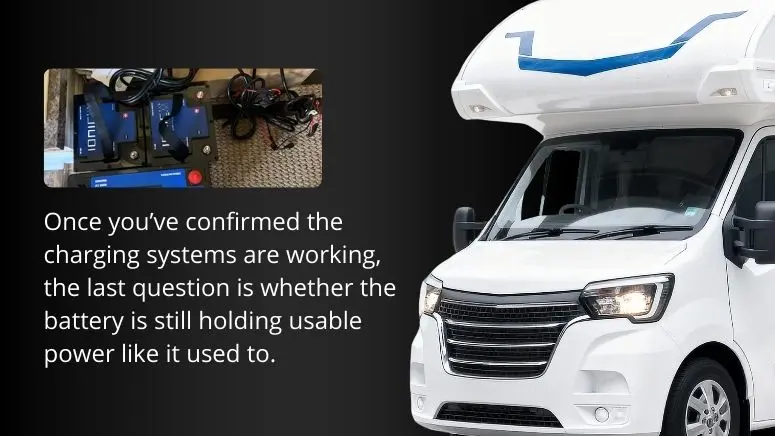
If it charges fast but drops fast, or cannot make it through normal overnight use anymore, the next step is looking at the battery itself, and that’s what we’ll cover in the next couple of sections.
When The Battery Is The Real Issue
If you’ve checked shore power, towing, solar, and the less obvious culprits, there’s one more possibility that’s easy to overlook. Sometimes the charging system is doing its job, but the battery itself is simply aging out.
All RV batteries wear down over time. The difference is how quickly it happens and how well they hold up to your camping style. A weekend here and there is one thing. Regular boondocking, heavy 12V use, long storage periods, or lots of partial charging is another.
Signs Your Battery May Be Near The End
- It seems to charge up, but drops fast under normal use
- You’re getting weak performance even after a long charge
- Everything checks out, but the battery still feels unreliable
- You’re needing workarounds more often, like running the generator just to keep up
At that point, it’s not always a charging problem. It’s often a usable capacity problem.
A Quick Capacity Check You Can Actually Do
- Fully charge the battery
- Let it rest for a few hours
- Use normal RV loads for a bit (lights, fans, water pump, fridge control board)
- Watch how quickly the voltage drops compared to what you’re used to
If it falls quickly under light, normal use, usable capacity is probably much lower than it used to be, even if the battery still “takes a charge.”
A Few Habits That Make Batteries Wear Out Faster
This isn’t about one battery type being bad. It’s just the reality of how RV batteries get used.
- Frequent deep discharges: running a battery very low again and again wears it out faster, especially with lead-acid battery types that simply can’t handle deep discharging.
- Long periods sitting partially charged: especially during storage
- Loose or dirty connections: not always the root issue, but they can limit performance and add stress
- Mixed battery banks: combining old and new batteries, or mixing different sizes and types, can create uneven charging and uneven performance
RV Battery Not Charging: Replace Or Upgrade
Once an RV battery isn’t holding usable capacity, troubleshooting usually stops being worth it. You’re basically at a fork in the road.
- Replace with the same type if your current setup has been working well for how you camp, and you need a reliable replacement RV battery
- Upgrade to a more robust setup if you want more usable power, faster charging, and fewer question marks when something feels off
That’s where lithium tends to be a great next step, especially if you’re tired of wondering whether you’re actually charging or just slowly falling behind.
Why LithiumHub LiFePO4 Batteries Make RV Life Easier
If you’re tired of chasing charging issues, it may be time to look at the battery itself, not just the wiring and settings. Our Ionic LiFePO4 batteries help cut down the day-to-day headaches behind “RV battery not charging” complaints because they accept charge efficiently and stay steadier under load.
But one of the biggest upgrades is simply being able to see what’s happening in real time, which makes troubleshooting a whole lot faster.
The Bluetooth Difference
Bluetooth monitoring changes how you troubleshoot battery charging. Instead of relying on voltage alone, you can open the app and see:
- State of charge percentage
- Voltage and current flowing in or out of the battery
- Cell balance status
- BMS alerts that point to specific protection events
It’s an easy way to know where you’re at before you head out, while you’re camping, or any time you’re deciding whether you can run another load.
Long Term Value
With a 3,000 to 5,000 partial cycle life, Ionic batteries outlast typical RV lead acid setups by a long shot. You also get more usable capacity from each charge, meaningful weight savings, and faster recharge times, which pair especially well with solar, too.
Solar-Compatible
You might start with shore power and add solar later, or run a mix of both. Either way, our Ionic LiFePO4 batteries are solar compatible, so you have the flexibility to expand your setup when it makes sense. A game-changer if you like to go off-grid.
Lighter, Cleaner, Lower Maintenance
One underrated upgrade is how much simpler lithium is to live with. Ionic LiFePO4 batteries are much lighter than typical lead acid RV batteries, which makes installs easier and helps keep your rig’s weight where you want it. And since there’s no battery acid to deal with and no corrosion-prone venting setup like a flooded lead acid battery, it’s a cleaner, lower-maintenance setup overall.
Ready to upgrade your RV battery setup? Check out our Ionic LiFePO4 RV batteries and pick the size that matches how you camp.
FAQs
Can I Mix a New Lithium Battery With My Old Lead Acid RV Battery?
Usually, no. It’s tempting as a quick upgrade, but a lithium battery and a lead acid RV battery don’t charge and discharge the same way. When they’re tied together in the same battery bank, one battery ends up doing more work, charging unevenly, and the whole bank gets harder to manage.
Is It Safe to Leave My RV Plugged Into Shore Power All the Time?
Most of the time, yes, as long as your converter charger is modern and drops into a safe maintenance mode. If you’ve got an older single-stage converter, leaving it on shore power for weeks or months can be rough on a lead-acid battery. A smart maintenance charger or a converter upgrade fixes that.
How Do I Know If My RV Battery Is Completely Dead and Needs Replacement?
If it “charges up” fast but drops fast, won’t hold overnight like it used to, or never seems to bounce back even after a full charge, it’s probably near the end. Voltage checks help, but day-to-day performance tells the real story. With LithiumHub LiFePO4 batteries, Bluetooth monitoring makes this way clearer because you can see the state of charge and whether it’s actually charging.
How Should I Store My RV Batteries During Winter?
Top them off, then stop the drain. For a lead-acid battery, that usually means disconnecting it or keeping it on a maintenance charger and checking it now and then. For LithiumHub LiFePO4 batteries, storage is easier because self-discharge is low, and you can check the state of charge in the app. Store above freezing, and don’t charge lithium below freezing unless your battery supports low-temperature charging.
Where Is the RV Battery Disconnect Switch Usually Located?
Common spots are near the entry, in a pass-through storage bay, near the main control panel, or right by the battery compartment. If your RV battery is not charging on shore power, this switch is one of the first things worth checking.
Why Is My RV Converter Not Charging the Battery Even When I Have Shore Power?
Usually, it’s not the converter, it’s the path to it. Think tripped breaker, popped GFCI, blown fuse in the charge line, or the battery disconnect switch still set to off. If all of that checks out and battery voltage never rises, then yes, the converter charger may be the issue.
Why Your RV Battery’s Not Charging When the Sun’s Out
Most “solar problems” are really setup problems. Confirm the charge controller is seeing panel input, set to the correct battery type, and that fuses and disconnects are on. Then check shade, dirty panels, and your power usage. If you’re plugged into shore power or running a generator, verify your battery charger is actually charging, too. Otherwise, it can look like solar is the problem.
Do I Need a DC to DC Charger for Towing or Alternator Charging?
Not always, but it’s a big upgrade if you rely on charging while driving. A lot of factory 7 pin charge lines are weak, so the battery might only get a slow top off. A DC to DC charger gives you a steadier, more predictable charge, and it’s especially helpful with LiFePO4 setups.